Project Overview

Project Info

Client: Kenshi Security

Type: Custom Notion Workspace for Software Company

Timeline: 13 July 2025 – 31 July 2025


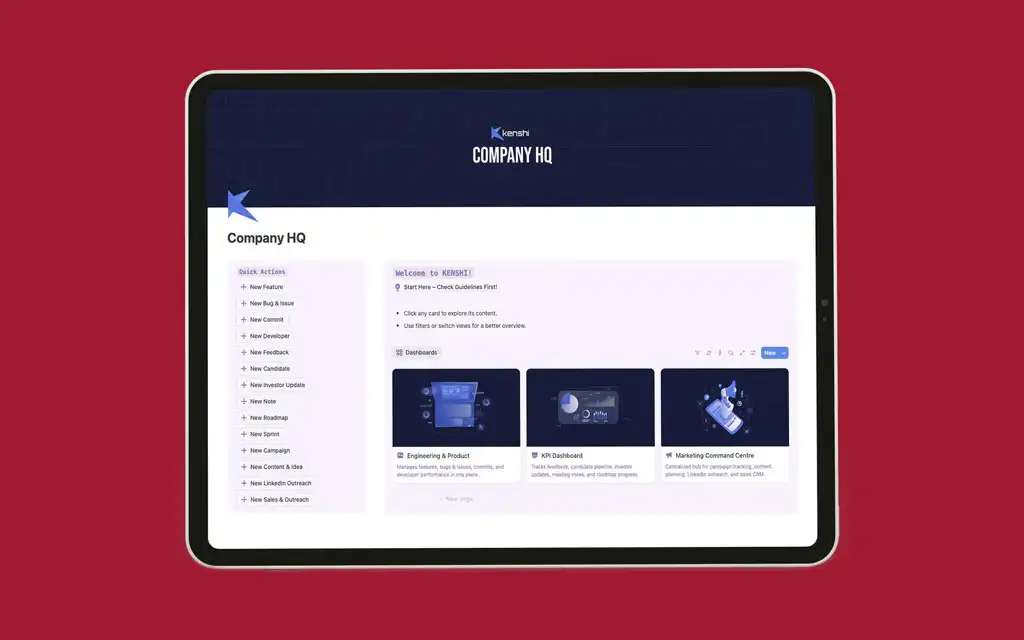
The client, Kenshi Security, needed a unified operating system to manage its core business functions, which appear focused on technology and gaming security. The purpose of this custom Notion system was to break down information silos between engineering, leadership, and marketing teams by creating a single source of truth. Based on the provided visuals, the project’s scope included designing a central dashboard with three specialized hubs: one for Engineering & Product development, another for leadership-facing KPI tracking, and a third for managing all Marketing and Sales outreach activities.


Client Challenges

Prior to this system, Kenshi Security likely struggled with disconnected workflows, a critical issue for a company operating in the fast-paced security sector. Critical data lived in separate, unlinked platforms, making it difficult to get a holistic view of progress. The engineering team’s feature backlog for systems like anti-cheat detection, the leadership’s investor updates, and the marketing campaign metrics were not integrated. This fragmentation caused inefficiencies, such as player feedback on false bans not being seamlessly actioned by the product team and sales outreach lacking a centralized CRM to track engagements, leading to potential missed opportunities and strategic misalignment.

Goals

The client wanted to centralize all company operations, accelerate workflow with one-click actions for common tasks, and provide real-time visibility into project status, performance metrics, and campaign results. The ultimate goal was to enhance cross-functional transparency and decision-making speed, ensuring that security product development and market outreach were perfectly aligned.

Requirements

The system required a central “Company HQ” homepage acting as a launchpad. It needed three distinct but connected pages: an “Engineering & Product” hub for tracking security features and bugs, a “KPI Dashboard” for logging player feedback, candidates, and investor communications, and a “Marketing Command Centre” for managing campaigns and outreach. Key requirements included databases for Features, Bug & Issues, Feedback, Candidate Pipeline, Investor Updates, Meetings, Campaigns, and LinkedIn Outreach, all with status tracking and filtering capabilities.

Design Steps

Home Dashboard

The Home Dashboard serves as the mission control for the entire company. It is designed for speed and clarity, featuring a “Start Here” guide and a set of “Quick Actions” that allow any team member to instantly create a new feature, log a bug, add a candidate, or start a new campaign from a single screen. This layout connects all departments by providing immediate access to the three main dashboards: Engineering & Product, KPI Dashboard, and the Marketing Command Centre. This ensures that no matter a user’s primary function, they can see how their work fits into the broader company objectives.

1

Engineering & Product

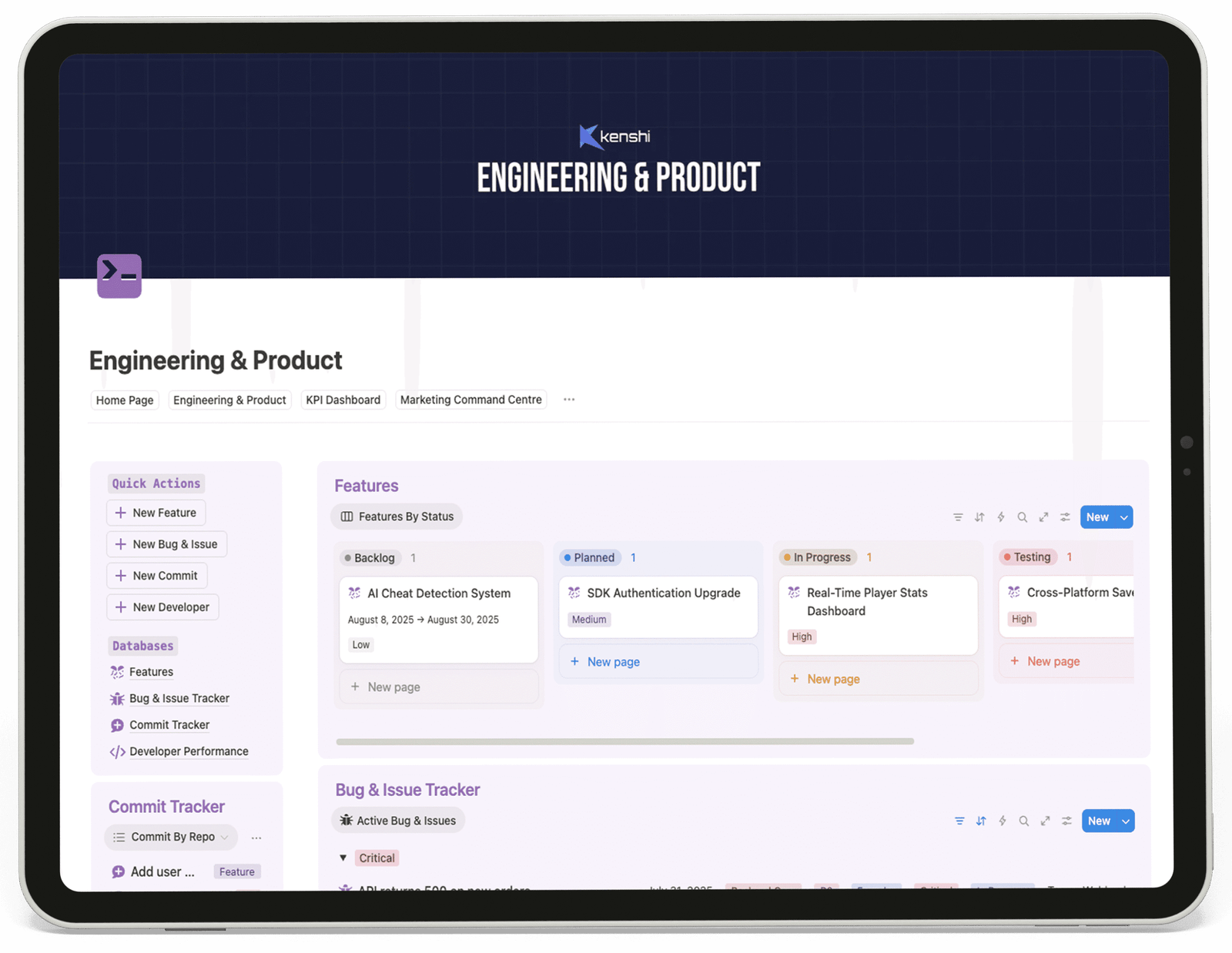
This page is the core of the development workflow for Kenshi Security’s products. Its purpose is to give a real-time overview of the product development lifecycle, crucial for managing complex security features. Key features include a visual “Features” board grouped by status (Backlog, Planned, Progress, Testing) highlighting projects like the “AI Cheat Detection System” and a dedicated “Bug & Issue Tracker” for prioritizing critical problems. This structure works for the client because it replaces multiple scattered tools with one intuitive board, allowing security managers to instantly assess sprint progress and developers to focus on high-priority vulnerabilities and features.

2

KPI Dashboard

Designed for company leadership, this page consolidates all strategic data. Its purpose is to track vital signs across the organization, from user feedback and hiring pipelines to investor relations. Important databases include the “Feedback & QA Log” for user suggestions and bug reports such as “False ban triggered by anti-cheat,” the “Candidate Pipeline” for recruitment, and the “Meetings & Notes” database for storing key discussions. This centralizes crucial information that was previously scattered across emails, documents, and other apps, enabling faster, data-informed strategic decisions for a company in a technical field.

3

Marketing Command Centre

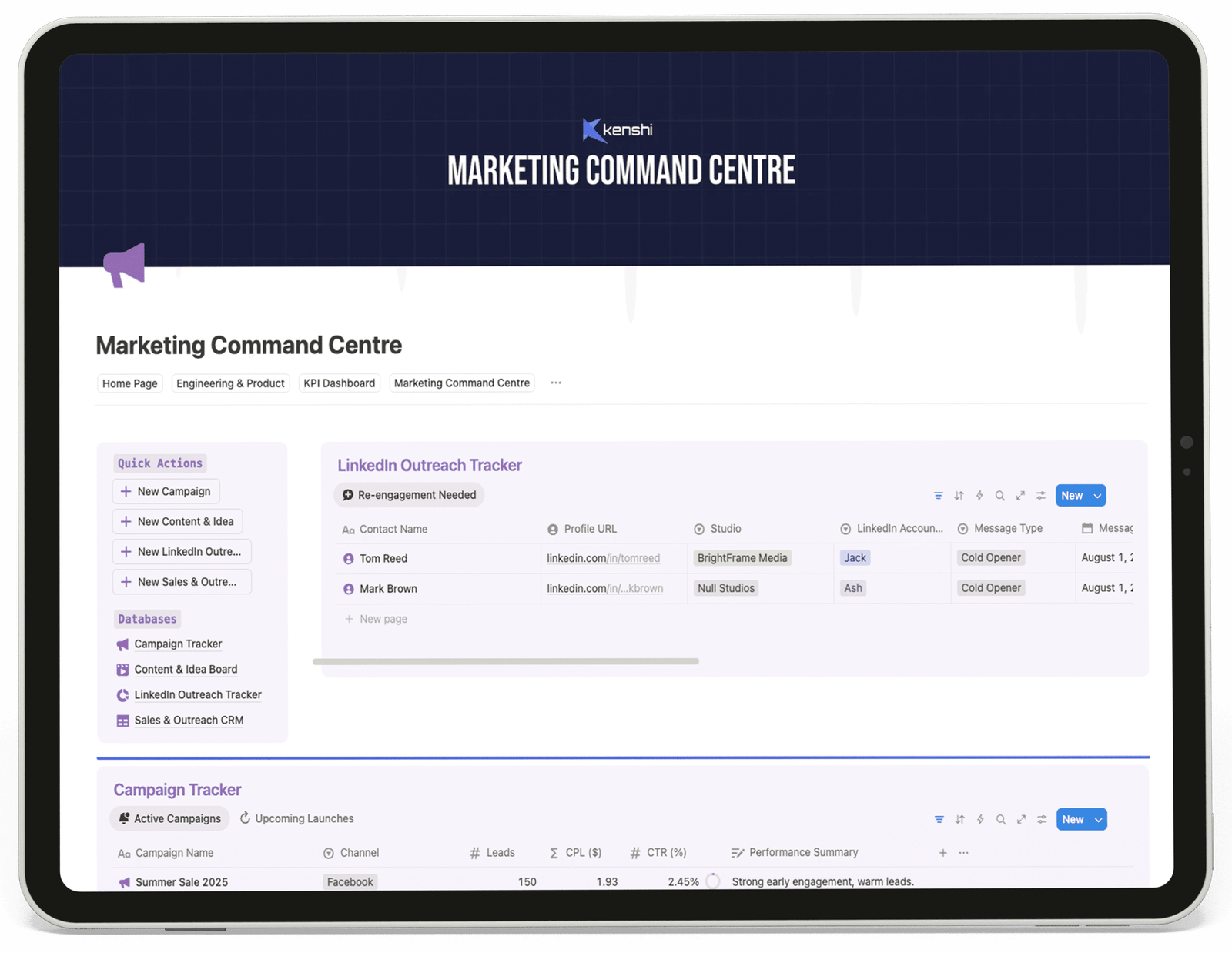
This hub streamlines all marketing and sales efforts for Kenshi Security’s services. Its purpose is to manage campaigns and outbound outreach from a single platform. Key features include the “Campaign Tracker” with performance metrics like Cost Per Lead (CPL) and Click-Through Rate (CTR), and the “LinkedIn Outreach Tracker” which manages contact lists, assigned team members, and message sequences. This structure works for the client by providing a clear view of campaign ROI and ensuring no sales lead is forgotten, directly linking marketing activities to tangible results in a competitive market.

4

Tools Used

Optimized For

This custom Notion workspace transformed our daily operations. It gave us the integrated command center we needed, making Kenshi Security more responsive and data-driven. It’s not just a new tool, it’s our company's central nervous system.
Ashley Game
Co-Founder Kenshi Security | UK

for exploring the entire case study. If you’d like to build something similar, feel free to DM me or submit your project requirements.

I’ll respond as soon as possible.